Western Regional Climate Center
November in the West
November, 2018
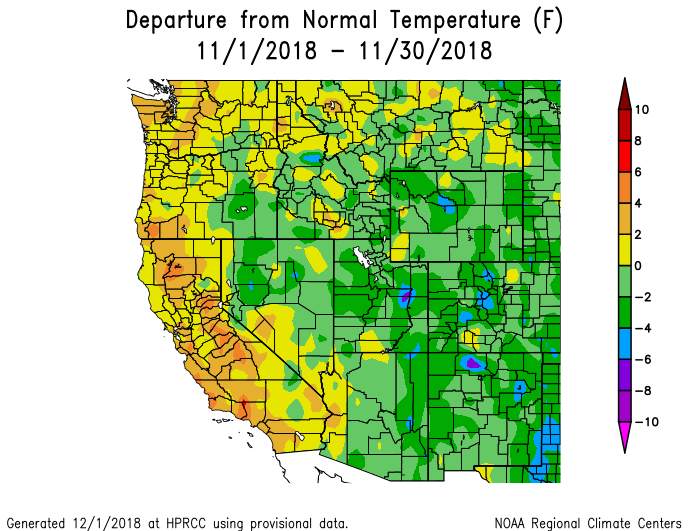
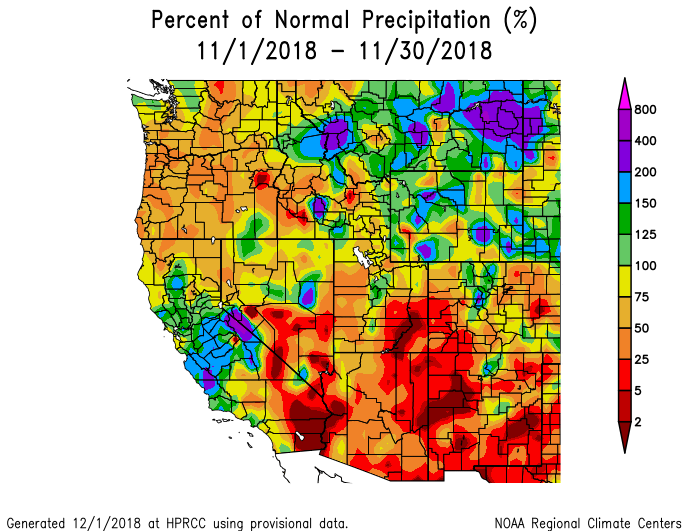
Above normal precipitation was observed this month across central California, Montana, and other isolated locations in the West. Precipitation was generally below 75% of normal in the Pacific Northwest, and much drier than normal conditions dominated across the Desert Southwest. The coastal states observed above normal temperatures, while areas east of the Sierra Nevada and Cascades observed temperatures near to several degrees below normal.
Following a dry start to the autumn season that primed the area for severe wildfires, several storm systems during the second half of November brought some relief to California. A moderate atmospheric river during the last week of the month impacted central California, bringing well above normal precipitation. Near the coast, Paso Robles reported a November total of 2.34 in (59 mm), 227% of normal. In the Sierra Foothills, the south entrance to Yosemite National Park logged 5.73 in (146 mm), 126% of normal. Above normal precipitation was also observed in the Inland Northwest; many locations in Montana observed persistent/frequent precipitation days. In western Montana, Missoula reported 2.57 in (65 mm), 254% of normal. This month's storms contributed to snowpack in the West, though some areas remained well below median. In the Pacific Northwest, most of the HUC-6 basins were reporting 50-75% of median snow water equivalent (SWE). The Sierra Nevada, western Great Basin, and northern Arizona reported more than 150% of median SWE, a great start to the season, though median SWE values are typically low in November. Near to slightly above median SWE was observed in the eastern Great Basin and much of the Colorado River Basin. Snow conditions allowed some Colorado resorts to have an early opening for the first time in nearly a decade.
Below normal precipitation dominated in the Pacific Northwest as well as the Four Corners region, allowing drought conditions to persist in these areas in the US Drought Monitor. Eugene, Oregon, reported 3.45 in (88 mm), 45% of normal. Albuquerque, New Mexico, received no measurable precipitation, while normal for the month is 0.57 in (14 mm). This has occurred in 23 other years in the station's 128-year record. In eastern Utah, Moab also reported no measurable precipitation, the third such November since records began in 1998. During the month of November, drought conditions expanded in California and Nevada owing to the dry start to the autumn season. Improvements to drought conditions were observed in the far Southwest and western Washington in response to a wetter than normal October.
California, Oregon, and Washington observed areas of above normal temperature this month. Seattle, Washington, reported an average temperature of 48.6 °F (9.2 °C), 3.2 °F (1.8 °C) above normal and the 7th warmest November since records began in 1945. In southwestern Oregon, Brookings reported an average temperature of 53.6 °F (12 °C), 3.5 °F (2 °C) above normal. In southern California, November temperatures averaged to 63.5 °F (17.5 °C) in Camarillo, 5 °F (2.8 °C) above normal and the 2nd warmest November since records began in 1952. Areas east of the Sierra Nevada and Cascades were within a couple degrees of normal to several degrees cooler than normal. Sunnyside, Utah, reported an average temperature of 34.0 °F (1.1 °C), 6.4 °F (3.5 °C) below normal.
Above normal temperatures dominated across Alaska this month, with many locations reporting one of their top-ten warmest Novembers. In northwestern Alaska, Nome recorded an average temperature of 24.9 °F (-3.9 °C), 8 °F (4.4 °C) above normal and the 8th warmest November since records began in 1900. In the interior part of the state, Fairbanks reported a November average temperature of 11.7 °F (-11.2 °C), 9.1 °F (5 °C) above normal and the 10th warmest in a 90-year record. The southern Panhandle remains in severe drought; precipitation this month was average in this area, but not enough to overcome the precipitation deficit. Across the state, precipitation was near to slightly below normal. Precipitation was generally below normal across Hawaii, though several windward locations reported above normal precipitation. On the southern coast of Oahu, Honolulu reported 0.34 in (9 mm), 14% of normal. In contrast, on the northeast (windward) side of the island, Kapaka Farm reported 10 in (254 mm), 140% of normal. Drier than normal conditions were observed across Big Island, Pahala, in the southeastern part of the island, and 0.83 in (21 mm) was recorded for the month, 17% of normal. The state of Hawaii remains free of any drought designations in the US Drought Monitor.
Significant Events for November 2018
Early November: Devastating wildfires in California: The Camp Fire in Butte County, northern California, was ignited November 8 during a period of high winds following drier and warmer than normal conditions. The fire impacted the town of Paradise, resulting in 88 deaths and 18,804 structures destroyed (as of November 30). The Camp Fire became by far the most destructive wildfire in California history, surpassing the previous record-holder, the Tubbs Fire of 2017, which resulted in 22 deaths and 5,636 structures destroyed. The Camp Fire also resulted in prolonged poor air quality in heavily populated areas such as Sacramento and the San Francisco Bay Area. During the same wind event, in southern California, the Woolsey Fire burned through 88% of the Santa Monica Mountains National Recreation Area, destroying 1,500 structures and causing three deaths.
November 2018 Departure from Normal Temperature and Percent of Normal Precipitation for Western United States